
Photo locations, techniques and technology. Highlights of locations we frequent as well as features on how and why we shoot the way we do, including gear reviews specific to nature photographers.
A7III and 100-400 GM - how did it come to this?
Depending on what you do and if you get paid for it there are a number of camera combinations that people think of as apropos for that genre. For amateur/enthusiast nature photographers it is often the medium resolution but reasonably fast midrange camera and a 100-400 lens.
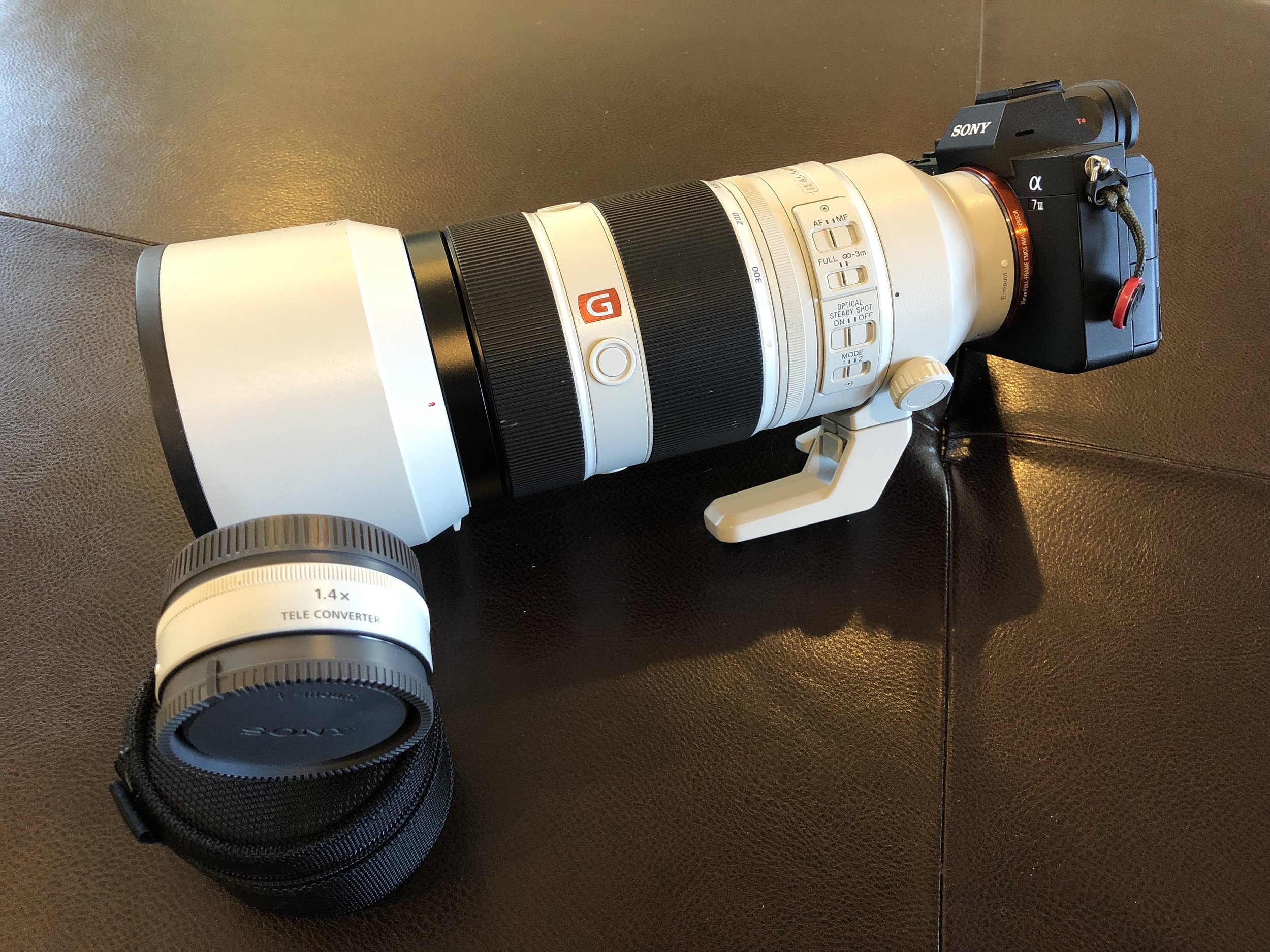
Sony A7III, 100-400 GM lens and 1.4X teleconverter
There are a few standard combinations of cameras and lenses that are indicative of the type of photography that you do. Canon 5DSR or Nikon D850 and 50 or 85 f1.2(4) for high res 35mm portraits, and Canon 1DXII or Nikon D5 and 400 f2.8 for professional sports photography can be considered typical (I know there are plenty of others). Depending on what you do and if you get paid for it there are a number of camera combinations that people think of as apropos for that genre. For amateur/enthusiast nature photographers it is often the medium resolution but reasonably fast midrange camera and a 100-400 lens. This combination tends to be the most versatile setup that doesn’t fully break the bank (without going to third party lenses) and Sony took their sweet time providing something that meets the bill.
I started playing with Sony cameras with the A7R and a wide angle lens for landscape work, I had a 70-200 for longer reach but the combination was not yet a good replacement of my canon setup for nature photography. Sony finally announce a 100-400 lens and by that time I was using the A7RII which had good (but not great) tracking autofocus. In single point tracking in good light this system worked well enough, but as you let the system do tracking with larger focus areas it tended to latch onto the background at just the wrong time....especially in backlight situations. The 5fps was adequate but not great and the buffer was rather sucky. Still this was a good combination to take out for higher resolution shots as I had my Canon 1DIV workhorse still at that time for the fast action.

Osprey shot from a kayak in Sparkleberry swamp on Lake Marion. 560mm at f/8, 1/2500s, and ISO 800 wide area continuous focus.
I got a good deal on a Canon 5DS and decided to retire my 1DIV but that left me with a bit of a hole for getting any burst shots and now I had no cameras with a buffer that didn’t leave me waiting in certain conditions.
At that time I didn’t want to spend the money on a 1D upgrade as 20 MPixels felt limiting for the amount of cropping I often have to do and I didn’t want that big of a camera anymore. The Canon 5DIV was compelling but still expensive and the buffer was as lacking as the 5DIII. Sony came out with the A9 that sounded great in terms of features but the price tag was pretty massive for a camera that I wasn’t yet sure if it would be all it was saying it was (turns out it was but I didn’t end up needing to spend the money). This is when the A7III came out with 10 frames per second, a reasonable 24 MPixel sensor with excellent autofocus and a buffer that can hold for the types of burst that I tend to do...quick small bursts but often many of those as things move by. Oh, and the price was way better than expected for all that came in that package.

Wood ducks shot in crappy light against what used to be a challenging background. 560mm at f/8, 1/640s and ISO 6400, wide continuous focus.
I do a lot of bird photography as well as animals from bear and elk to alligators. I don’t tend to have the issues that sport photographers have with picking out a single subject with a ball and tracking them through a sea of other similar subjects. Usually I’m looking at a single subject or if a group I’m trying to get the closest one or expanding to get as many in focus as I can. From that perspective the A7III wide focus group is amazing picking out and holding onto moving subjects quickly and effectively. I can change to one of the other modes quickly and the joystick is excellent for quickly moving the points around ( I have tried the touch screen but so far I have found that I accidentally change the point with my face or finger without knowing it and often have to move it again as I bring the camera back to my eye.

Black bear in the cherry trees. Cades Cove, Smoky Mountains National Park. 560mm at f/8, 1/320s, and ISO 3200.
What do I like:
New battery - this was definitely one of the biggest issues with the previous versions of Sony mirrorless cameras and the fix was not just noticeable, it was pretty fantastic for a battery that is still fairly small. This is really the only major thing that annoys me about the A7RII and the four batteries that I have to carry around with it.
Joystick - accessing focusing points was painful in previous cameras, this is still the easiest way to do so especially when you have gloves on in the cold.
Touch screen - pretty useful for tripod work but so far I have found I accidentally touch it when I don’t want to when my eye is up to the eyepiece….I have found this with all touchscreens from all companies so far.
Weight - definitely lighter than the canon setup that I have and every pound counts when you are backpacking into a site.
Autofocus - This is likely the best feature of any of the latest Sony cameras, not only is the autofocus fast and the tracking excellent the feedback in the viewfinder makes it so easy to really tell that you are in focus and that the tracking is keeping up. I can’t wait to see the updates that are supposed to improve on what is already pretty great.
Teleconverter - very sharp, all focus modes work even at f/8, I wish others would provide theirs with a nice little hard case like this.
Tripod mount - easily removable foot but once on it is not going to accidentally fall off.
Programmable buttons - on both camera and lens. Between this and the function menu I rarely need to go into the menus when shooting.
On the Lens - Copied canon’s new 100-400 on the smooth/tight lock and the polarizer window on the lens shade. Also copied them on the image quality….excellent on both.
Low light capabilities - I have been able to shoot in light conditions with this setup that I have never been able to before.
Dual cards - redundancy for both stills and video

Red Morph Screech Owl after dark. 400mm at f/6.3, 1/13s, and ISO 6400. Kudos to the image stabilzer and ability to focus in almost no light.
What would I change:
Viewfinder - works well but I would love to have had higher resolution....I do realize that this was something that they did to reduce cost and differentiate this entry level camera from the more expensive ones.
Silent shooting - this is a great feature to have and works well for birds at rest or animals moving slowly but I would love to see them improve the electronic shutter for action shooting. This will likely come to us in the future as the technology from the A9 makes its way down the line over the next few years.
Touch screen - is ok, works well enough from a tripod for touch focus but Sony really needs to make these cameras so that you can do everything either by screen or by buttons/wheels....having multiple ways to accomplish things is very useful for tools that are used in so many different ways.
Vertical grip - I have the vertical grip and extra battery for this setup but have found that I don’t really use it that often. I am very used to the feel of the Sony bodies now and they fit my hand. From a power point of view, I just carry one extra battery in my pocket and that is usually enough for a couple days of shooting for me.
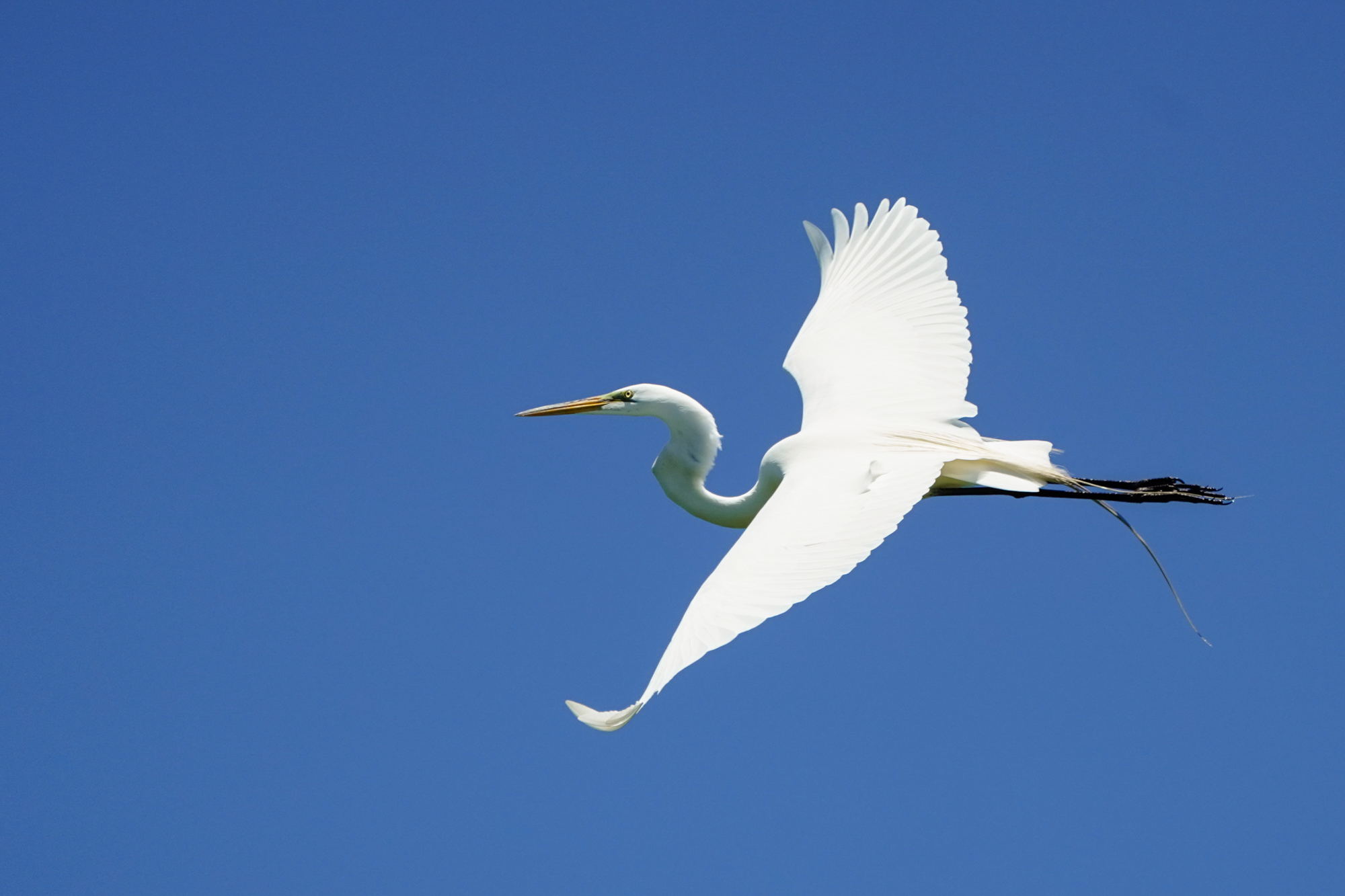
Great Egret in flight. 400mm at f/5.6, 1/2500s, ISO 400
Final Thoughts
I’m really looking forward to the updates to the firmware coming this spring to improve ‘real time’ tracking and especially to see how the animal eye focus tracking works. I’ll very likely write something on that as soon as it is available.
Although I would still love to have the A9 in place of this camera I am very happy with the extra money for a couple more trips as the A7III has almost everything I need. Same goes for the A7RIII, if I didn’t have version 2 already I would likely have gone for it but it is really nice to have both a high resolution and a fast camera, both available at the same time. I’ll always be wishing for a little faster and a little more detail but really there is little to complain about with this setup. If you are looking for a mid range nature setup this is a good step up from the typical apsc camera and 70-300 or even the 150-600 that many people start to get into nature photography. It definitely is competitive with anything Canon and Nikon have in the price range ( approximately $2000 or so for the camera and $2400 USD for the lens)
Tech News - New release from Olympus
Olympus has been teasing a new camera for weeks now that could very well be a fantastic nature photography tool, but I don’t think that was the most important announcement for nature photographers.
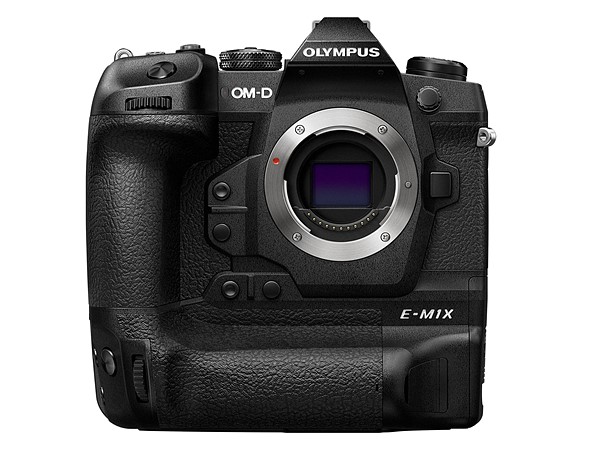
Olympus has been teasing a new camera for weeks now that could very well be a fantastic nature photography tool, but I don’t think that was the most important announcement for nature photographers.
First, the camera. The new E-M1X is a 20MP micro four thirds camera that can shoot 18 fps with full tracking autofocus using 121 on sensor cross type phase detection focus points that work with contrast detect focusing and what they are referring to as deep learning (AI) algorithms for object detection. It can also do 60 fps with the focus locked at the first shot. The with mechanical shutter it can do 18 fps single focus and 10 fps continuous. There are many other features including handheld high res, and other multi-shot modes (exposure bracketing that they are calling live ND). DPReview has already put up some great articles on the specs, sample shots and hands on reviews.
This is all great, but the real interesting thing that came out of this release was a notice that they are building a new 150-400 f4.5 lens with built in 1.25 teleconverter and they also announced a separate 2X teleconverter. From a nature photographers point of view this could be amazing. Equivalent reach of a 300-800 lens in a package that looks at least slightly smaller than Canons 200-400. With the 1.25 teleconverter you have a 1000mm that you can handhold. Depending on the minimum focus distance this could be a fantastic lens for birding (especially small birds) that I would really like to get a chance to use.

The 2X teleconverter will be very interesting as well, but I’ll wait to see on this one since I have yet to be really impressed with any 2X teleconverters from any company.

Who knows, this set of announcements could lead me right back to where I started with mirrorless cameras on the micro 4/3 platform. I do have one request for Olympus…please come out with animal/bird eye detect in your AI algorithms and you will have something for birders that won’t break their backs.
Shooting the lunar eclipse
After getting a great chance to shoot the solar eclipse a couple years ago, I’ve been itching to point the cameras back up in the sky. I did a good bit of research into the shoot and thought I was pretty well prepared….

Setting up cameras for the January Lunar Eclipse
After getting a great chance to shoot the solar eclipse a couple years ago, I’ve been itching to point the cameras back up in the sky. I did a good bit of research into the shoot and thought I was pretty well prepared, I had the Canon 5DS with the 500mm and 2X teleconverter on one tripod with the jobu jr. gimbal head and a wireless shutter release. On a second tripod (that has a simple manfrotto video head) I put the Sony A7RII with the 100-400GM and 1.4X teleconverter.
Salwa was using the Canon 5D III with the 100-400 L II and 1.4X teleconverter on her travel tripod. As the Moon came over the little mountain ridge behind our house we took a few practice shots to get our settings right. I had watched where the moon was traveling the night before and thought I had a pretty good idea of where and how to get the sequences. Interestingly, this was where we had significant issues getting the shots…especially since the weather hit us with the coldest temperatures of the year so far.

Start of the partial eclipse
The eclipse was going to be 4 or so hours of shooting so that we could get everything from the full moon, through partial to the full red moon and back again.

Partial eclipse moving quickly towards full lunar eclipse.
This shoot turned into a major learning exercise:
didn’t realize how vertical the angle of shooting would be and that some of the setups were going to be problematic.
Video head couldn’t go vertical enough and I couldn’t use it during the full eclipse but it was the easiest one to keep centered on the moon since the handle made for easy small movements and the Sony camera was easy to use with the tilting screen.
The jobu gimbal definitely had better range of motion but with the wind was a major negative factor with the 1000mm.
The Canon 5DS is a great camera but the lack of a tilty-flippy screen made things really difficult in combination with trying to shoot nearly vertical on a freezing cold night. I do have a black magic monitor and I think that I will have that ready for a shoot like this next time although I would need external power supply for a 4 hour shoot.
I have also learned that I will likely need some sort of windscreen for that big lens as well as some weights on the tripod.
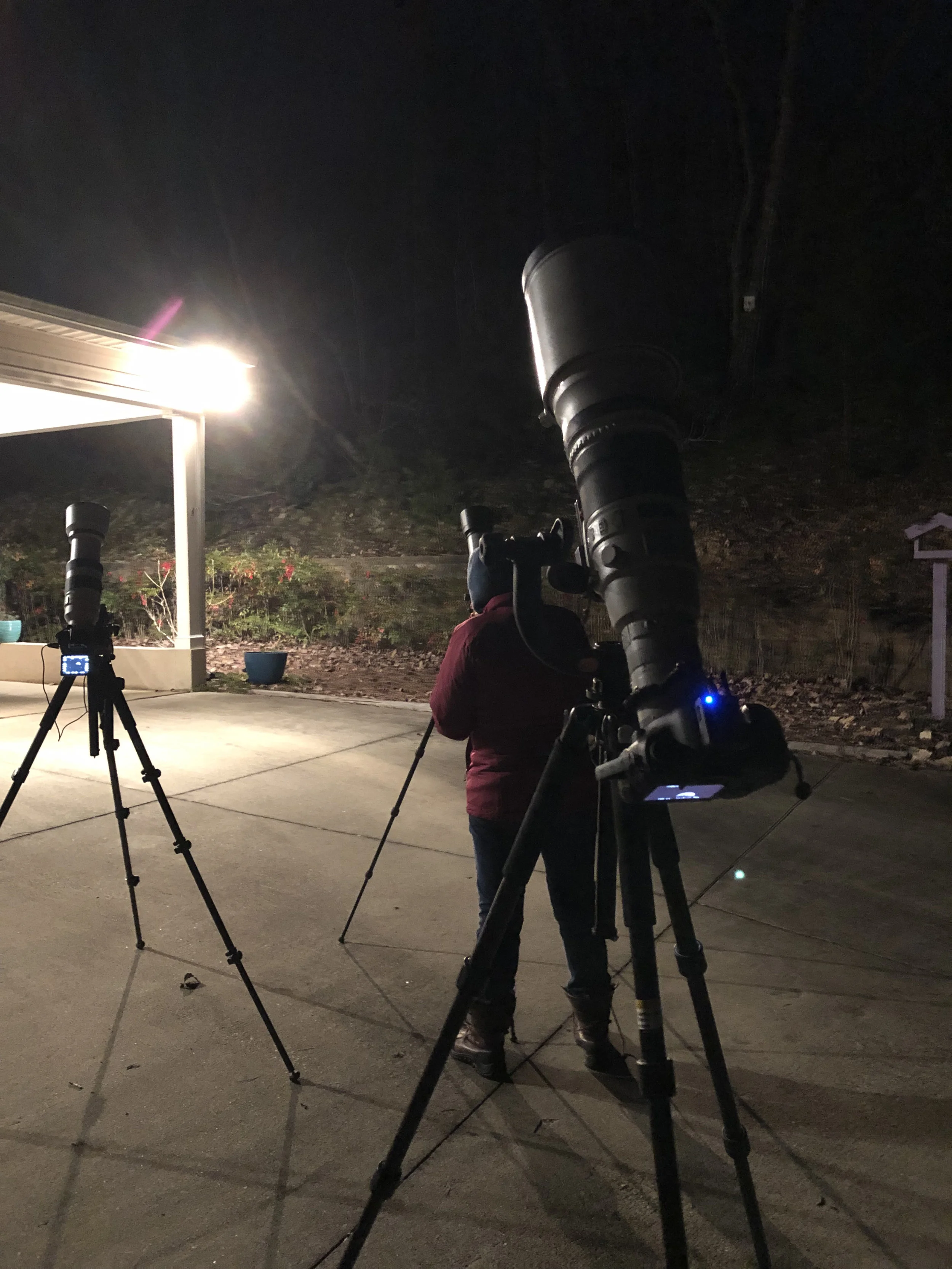
cameras pointing nearly vertical during the eclipse. That flippy screen on the Sony made things so much easier than trying to look at the Canon….too bad the tripod head that I used on the Sony wouldn’t go much more vertical than what you see here.
I also think that the 2X teleconverter was probably the wrong choice as it does reduce image quality and with the length every little movement is exaggerated.
I actually replaced the 5DS for the last half of the shoot with my Canon m50 (and removed the 2x teleconverter).
I’ve been considering a Goto astrophotography mount for the last few months (along with an actual telescope) and am now ready to put money down on one as longer exposure shots of stars, planets and things like these eclipses you can stop worrying about keeping your subject in the frame and think more about getting the shots you want. Looking seriously at the sky-watcher Skymax 102 AZ-GTi 102mm f/13 GoTo Maksutov-Cassegrain Telescope.

Full eclipse, subtle red colours and nice shadows….would have liked a bit more detail in the shot but this was as good as it got.
With all those issues we were still reasonably happy with the shots we got. As it turned out, the atmosphere was not the best for shooting even though it looked clear so we were not going to get amazing detail but I think I captured the moments and the sequence in a way that I’m happy to look back at the shots. Of course, now comes the hard part. I have a few shots that stand alone but I think that I need to produce a composite that shows the entire sequence in a way that looks interesting but also isn’t necessarily just going to be like all the others I’m expecting to see on the net in the next day or two. Stay tuned….

Partial eclipse

more partial eclipse

getting close to full eclipse, nearly time to change shutter speed significantly for total eclipse

near the end of the full eclipse, light is starting to come strong on the upper left of the moon.
Sony A6400 and firmware updates for A7(R)III and A9
Sony had a press event yesterday to announce their new APS-C mirrorless camera that seems to be an update to the A6300 called A6400.

Sony had a press event yesterday to announce their new APS-C mirrorless camera that seems to be an update to the A6300 called A6400. Updates seem to be mostly software (and likely processor) based as the camera itself has not changed much physically except for the LCD screen which is now able to rise up fully over the top of the camera. With a starting price of $899 USD, a bit lower than the entry price of the A6300 this seems to be a compelling mid level camera with it would seem some amazing autofocus abilities but it leaves out in body image stabilization that likely will come in the A6500 replacement soon.
More interesting for me is the announcement of firmware updates in the near future for the A7(R)III and A9 cameras. These updates are improving on the focusing algorithms and will include something that I’m very excited about….animal eye tracking. Can’t wait to try this on my A7III when it comes out.
Software updates are due in April for A7 series. The A9 will have a first update with considerable improvements in March and a second one in July for the animal eye focus.
For some details on the firmware and the camera there are good articles on www.sonyalpharumors.com and petapixel.com that cover most of the details.
Using mirrorless cameras for nature photography (My progress over time)
I started with a little point and shoot canon and quickly got hooked on taking shots and on how to improve the shots that didn’t look as good as I wanted. I started, and continue today, to use Canon cameras….point and shoot, then Rebel, moving up with my skills and as my budget allowed.

Size comparison of my Canon and Sony systems with equivalent 100-400 lenses.
I consider myself a nature and landscape photographer, but I have to admit I really enjoy the technology around taking pictures and video nearly as much as I enjoy being in nature. I started with a little point and shoot canon and quickly got hooked on taking shots and on how to improve the shots that didn’t look as good as I wanted. I started, and continue today, to use Canon cameras….point and shoot, then Rebel, moving up with my skills and as my budget allowed. As with computers, I have never felt like I could only use one brand and have looked at different tools when they did the job easier. I currently use both Canon and Sony cameras often one of each on a shoot but have recently been asked quite a few questions as people see me carrying Sony gear while shooting some challenging nature work.
I’ll start with a bit of my progression since Sony was not a great choice for many reasons in the beginning but has become not only much better, but in some cases, the best choice for me in certain situations now.
First generation mirrorless Sony cameras had contrast detect autofocus only and were really only good for static shots of perched birds or maybe slow moving animals.
I first went mirrorless with Panasonic GF1 and later GX1. The micro 4/3 system seemed to have a lot going for them with significantly smaller lenses for the reach you could get and the picture quality in good light was good enough for moderate sized prints. It was nice at the time to be able to get 600mm equivalent with the 100-300mm in a system I could carry in a small sling bag.

Panasonic GX1 with 100-300mm (600 equivalent field of view). A compelling system but autofocus tracking was my major limiting factor with this system. Maybe Olympus will change this with the new EM1 successor that is to come out.
There were two issues with these cameras for the types of photography that I was doing at the time. Since I shoot owls regularly and they tend to start being active at dusk and sometimes stay active just at dawn, low light noise is a major factor in the types of cameras I want to use. As you increase the sensor size (in general) for cameras of the same or similar technology you get better low light capabilities. The second is that due to the fact that I would like to capture in-flight shots and interactions which means both a higher shutter speed (again low noise at higher ISO to achieve those shutter speeds) and good autofocus tracking.
The first Sony camera I got helped in low light even though the A7R had a fairly high number of pixels, when you reduced shots taken in low light to @20 MPixel you were able to have excellent low light shots. This camera was also a great landscape camera and I used it mostly for those types of shots over it’s lifetime. The problem was that the autofocus not only wasn’t better than the Panasonic it was actually considerably slower, even for single shot. Then along came the A6000.

Sony A6000 and A7R, a really good start but Sony was going to quickly improve on these cameras
The A6000 was the first mirrorless camera that changed my way of thinking about autofocus. I would rarely use anything more than 9 points on my Canon camera for continuous focus and more often than not, would only use center point and have to always crop my shot for the composition I wanted later. With this camera I could use either all points or a slightly smaller (but still bigger than the full focus on my canon) box and I could watch the little green dots follow my subject in real time. Along with 10 frames per second I was able to frame my shot in real time and (most of the time) keep focus on the subject. The software was not perfect at this time, it would lose the subject where the background was complex and contrasty. The ability to keep focus would drop off considerably as the light diminished. As an APS-C camera, the low light capabilities were good but not great. The best thing was that I was sure this was a good sign of things to come for the next generation of full frame cameras.
That lead to the A7RII for me. This camera at the time was nearly everything I was looking for. The autofocus was similar to the A6000, it had more resolution than my A7R and it seemed to have better low light capabilities as well, even with the higher resolution. With more and more lenses coming out I was finally able to get a 100-400 and a 1.4 teleconverter (whereas before the longest native lens I had was a 70-200). This combination finally became as usable as my Canon setup….but not necessary better. There were things that Canon still did better and things now that the Sony combo was better at.

Pretty much a full set of lenses for me, 16-35, 24-105, 100-400 with or without the 1.4 teleconverter (and a 70-200 for video). Pretty much matches my Canon setup except for the 500 f4.
The A7RIII came out and I wasn’t sure that it was worth upgrading even though the autofocus was considerably better, 10 frames per second was pretty compelling, and that new battery was a big improvement. The A9 also came out and I thought that might be the perfect nature camera, especially with the silent shutter that is actually good enough to capture moving subjects without any distortion. However, the cost of that camera had me sitting on my money as I could have picked up a used Canon 1DX for that kind of money and I wasn’t convinced, at that time, that it was in the same league.
This is when Sony did something very unexpected. They came out with the A7III with the same resolution as the A9, 10 frames per second, excellent autofocus, the new battery, 2 cards slots, and a price that had up until that time been relegated to “budget” full frame like the 6D or D610. I almost forgot, it also had some pretty good video specs as well which was something I was starting to get more interest in at that time. So instead of replacing my A7RII with the A7RIII or blowing my budget on the A9, I kept the A7RII and picked up the A7III as well. Now I had a combination that I felt matched most of my Nature shooting and I found I was leaving my Canon equipment at home more often (unless I needed the 500mm). I could hike with 2 cameras and 3 lenses (16-35 f4, 24-105 f4, 100-400 f4.5-5.6) that were all interchangeable and I had high resolution as well as speed and excellent high ISO capabilities.
This is the current state for me. I’m sure with the new mirrorless cameras that have come out from Canon and Nikon (and Fuji for that matter) we are in for even better cameras in the next couple of years.

I really love the A7RII for landscape photography.
What do I expect? In the next generation of cameras, I’m expecting some fantastic things for nature photography. We are very likely to see fast silent shutters make it down to more affordable cameras, likely with Sony taking the lead on this. Autofocus is improving very quickly as processors get faster at looking at the live image and actually using that data in near real time. I’m also expecting to see usable eye autofocus for birds and animals in the next generation of cameras. Tracking objects is improving steadily, and algorithms are getting more robust. I expect Canon and Nikon to put out something before the next Olympics that will be interesting, and possibly catch up to Sony on some of these fronts. The next couple of years are likely to be exciting as these companies jockey to gain/keep their hold on the market and I expect that there is going to be some fallout, just not sure who is going to make a mistake or decide they can’t compete.
Video is going to be more and more important in these systems, and Canon and Sony have a bit of an edge to start but Nikon and Fuji have now put out some surprisingly good products. Panasonic and Olympus seem to be the bigger question and we shall see as one sticks their foot in the full frame game and the other looks to try to compete in the sport/nature game but stick with the micro 4/3 platform with the EM1 successor.

For nature shoots I commonly carry the canon 5DS with a 500mm and have a sony (either a7III for faster subjects, or A7RII for environmental shots) hanging from my shoulder.
Next I’ll cover some questions that I get asked about using Sony out in the field.
Autofocus - many questions here
Sony started with autofocus that was accurate but so slow it was only good for static subjects (on the mirrorless front, the SLT cameras are a different story). Each generation improved both the technology (on sensor phase detection, increasing the number of points, speed of detection) and the software (ability to detect objects, tracking algorithms, eye AF) with the current version 3 having mostly caught up to Canon and Nikon and in some areas actually surpassing them. The challenge with any autofocus system is learning it. It took me years to get the most out of the Canon system and to know when to use what methods. Likewise it took time to learn the Sony system. I have found that I don’t use the same methods for the same subjects. I will use all focus points and let the camera do the work of tracking with the A7III for most bird in-flight shots, whereas with the Canon I will most often use 9 point in the center for those same conditions. Using all points on the Canon I would often lose focus to the background, and using small cluster of points on the Sony seems to limit my composition unnecessarily. I have not used all of the track and follow methods of the Sony yet, my first trials were not as successful as I had wanted. Single point in lower light is still not as good on the Sony as on the Canon. The state of focus tracking on all systems is so good compared to what I started with 15 years ago, most of the time missing the target is more often human error than the camera.
This will likely be the subject of another post on its own and hopefully I will put out a video showing some techniques as I get better at documenting things while they are happening.
Weather sealing - I personally have used (and am comfortable with) all the Sony cameras in the same places that I use the Canons. I would never, on purpose, shoot any camera in the rain and will use rain covers like Lens Coat when I’m in bad weather. My main experience with challenging weather is in very hot and humid conditions or very cold conditions. In humid conditions I have only ever had 2 issues with a photography equipment, a canon xti in which the SD card failed in Costa Rica, and a Tamron lens that fogged on the inside in the rainforest in Northern Australia…that lens is still working fine today and only needed to be in a dry area for a few days. I regularly use all cameras in the swamps of South Carolina and Georgia, in very salty conditions on the coast (we do product shoots for a sailing catamaran company). I also regularly shoot in very cold conditions ( < -30 °C) searching for hours for owls. I guess the point is that the weather sealing is good enough for me for these conditions and the way I ensure my equipment stays safe. I will leave actual tests of the failure points of each one to people who can afford to break their equipment.
Build quality - After saying what I did above, I have dropped my Canon 1D IV on volcanic rock in Maui, fallen with it down a scree field, bounced the camera of the side of a rock face while shooting bouldering and still managed to sell that camera last year with only a few scratches. I do not believe any of the Sony cameras I have would fair as well. The build quality is solid on these machines but they are not in the same class as a 1D, I would put them equivalent to the 6D or 80D which are still very good.
Battery Life - After using a 1D for 5 years pretty much any other camera that I have falls significantly short. 2 batteries would last me an entire week in the woods. On the other side of the spectrum is the A7RII. I have 4 batteries and will use 2 a day easily when shooting it as primary. I definitely need to be within reach of power every 2 days with that camera. This changed significantly with the A7III. This camera last about the same amount of time as my Canon 5DS and both of these cameras can usually go 2 days per battery. This is the one major reason I will upgrade the A7RII at some point.
Lenses - I have been using Sony mirrorless since the beginning so have had to deal with the early lack of lenses. Since I was doing mostly landscape with these cameras at first the 24-70 f4 and 16-35 f4 were good (well the later was good the former just good enough). I was also able to use all my Canon lenses for landscape easily with the metabones adapter since autofocus was not a huge issue. In the last year I was able to pick up the 100-400 and the 1.4 teleconverter to which was also my go to combo for the canon system for years before I was able to get a 500 f4. There are some fun lenses I would like to pick up but now that I have the 24-105 f4 in place of the older sony/zeiss 24-70, I have all I regularly use on any given shoot. Quality wise, I have the same lenses on Canon and am equally happy with both systems.
Ergonomics - This one is very personal to almost everyone. Personally I find both Canon and Sony cameras very easy to use. They both take time to learn well enough (and to customize to the level I’m happy with) that I can do most of what I need without thinking and rarely in the field need to go to the menus. Unlike many complaints I have seen, since I use long lenses a lot the size of the camera is not really relevant because most of the weight is on my left hand and my right hand guides the camera. Now that the Sony has a joy stick, I don’t have anything to complain about for Canon or Sony. I do like how small and light I can go with the Sony A7RII and 16-35 for long hikes to landscape locations…it may only save me a pound off the equivalent in Canon land but it is nice.
Support - I do not have CPS but anytime I have had an issue with canon equipment it has been fixed quickly and when not my own fault, Canon has done the work without charge. I have had excellent experience with Sigma when my 120-300 image stabilizer died. This is one area that I have not had good experience so far with Sony. I scratched the 100-400 lens a few months back (my own fault, did not expect Sony to fix it for free). I sent it in for an estimate and it came back at $1800 to replace the outer element. Nearly the price of the lens itself. I decided not to get it fixed since it really doesn’t affect the image much (but I’ll never be able to sell the lens). When it came back, my camera guy (yes I have a camera guy that has been taking care of both of us for 14 years now) asked the Sony rep who was in the store to see if they might be able to do something a bit more reasonable. In the end, all I got was a bit of a sneer and was told to use a filter next time. I guess I was more annoyed by the attitude than whether or not they might try to do more, but it has left a bad taste in my mouth.
Video - I’m just learning to do more video so the capabilities of all of my cameras are not the going to be the limiting factor for quite some time. The A7III does make things very easy compared to any of the other cameras I have used before. I have very little experience with any of the Canon cameras with DPAF so can’t compare them yet, just bought a m50 for use with the DJI ronin-s so will likely do some comparisons between that and the A7III soon.
Stabilization - I love the in body image stabilization. I can handhold shots I would never consider before with any lens I have. There are many times I would like to have a tripod but the weight is just too much for the hike. In these cases the Sony cameras mean I can use any lens now in those conditions.
Colour - not an issue with me as I adjust white balance for each shot depending on how I feel the scene should look. Out of camera, Canon seems “warmer”, Sony seems “colder”, both can be adjusted to what I think I actually saw.
Noise - With Canon I tend to shoot to the right since shadows can be a challenge to recover an the noise is a bit ugly in those areas. With Sony I don’t need to worry as much, I can expose for the scene and recover shadows more easily. I rarely feel limited by either system.
So for now, I have some excellent equipment and I use all of it together depending on what I am shooting. I’m looking forward to all the tech that is likely to come in the next few years, from improvements to the smaller sensors, to the ways that autofocus is going to seem almost simplistic and just to the competition in the market place with so many good products looking to get our attention. If anyone actually reads this far and would like me to go deeper into any of the subjects above leave a comment. We will be working on some videos soon and may cover these areas as we learn what to do (and likely show you what we found doesn’t work).