
Photo locations, techniques and technology. Highlights of locations we frequent as well as features on how and why we shoot the way we do, including gear reviews specific to nature photographers.
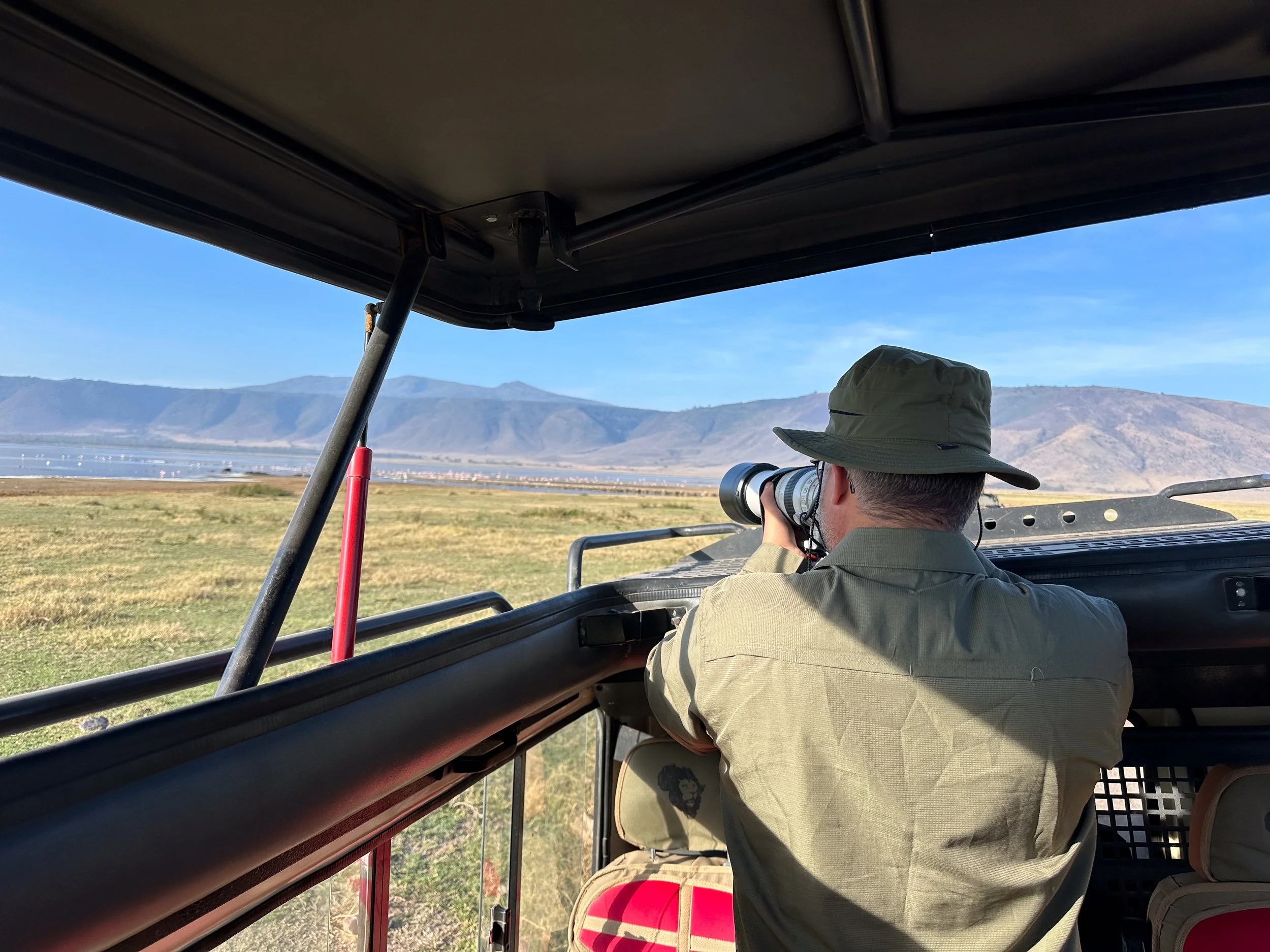
Did I bring the right gear to Tanzania?
I spent a lot of time before our trip looking at what other people suggested for the best gear for a Safari in Tanzania. Now let’s see if I made the right choices.
I spent time researching what other photographers take on safari. I asked other photographers what they found they used the most. I watched YouTube videos of safari trips as well as professional photographers out on safari shooting daily. Taking all that information into consideration I wrote an article on what I was going to bring with me, and it was pretty close to what I did actually take. The excepion was was the Sigma 500mm prime which I left at home. So how did it work out you might ask...or at least I'm going to answer that question whether or not you ask.
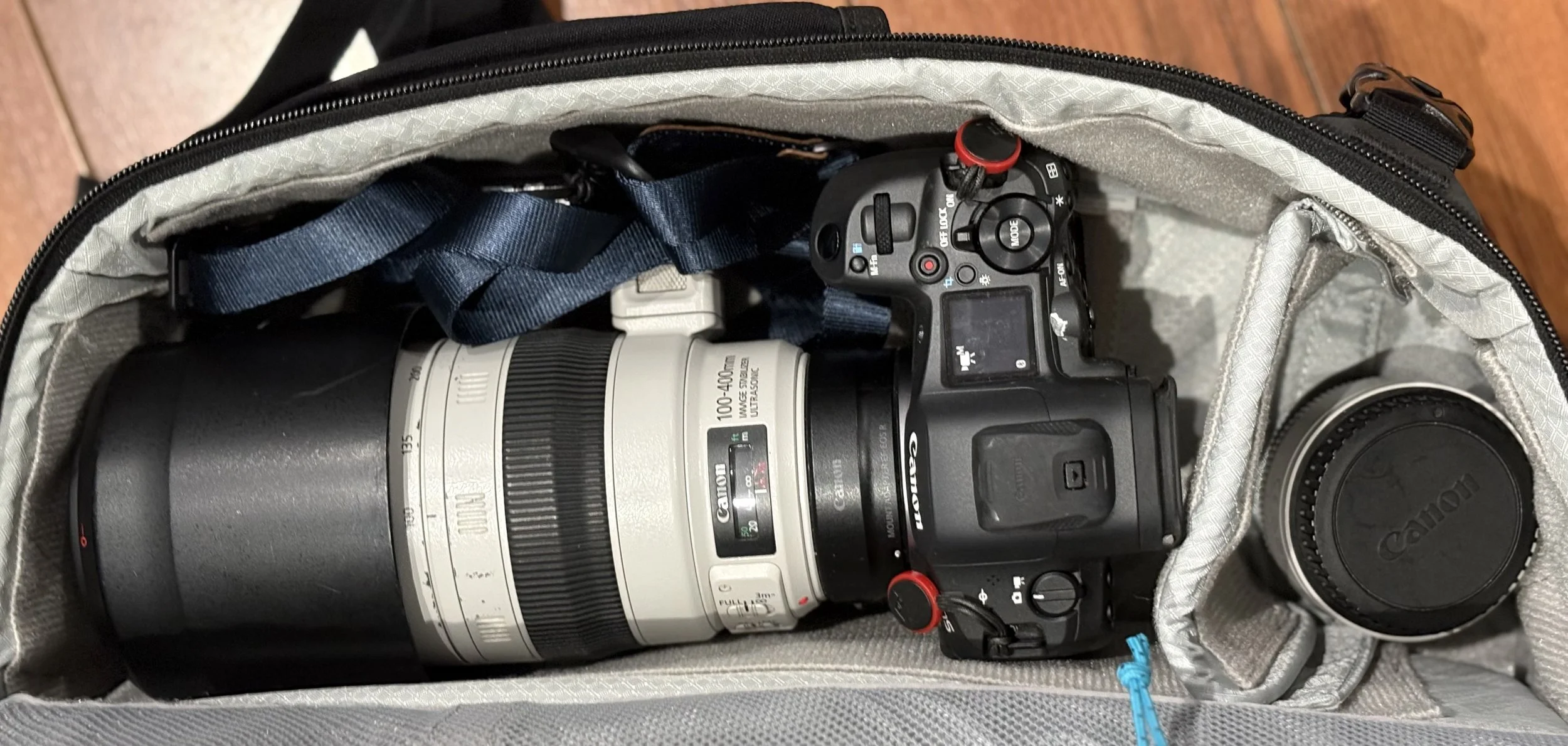
The Canon side of the bag with Canon R5 II, 100-400mm EF L lens and the 1.4 x Teleconverter
The thought was that I would prefer to have a telephoto zoom lens on one camera, and a wider lens on a second camera that would cover 90% of the focal range that I’d shoot while in the safari vehicle. I started with the 100-400mm lens on the Canon R5II and the Tamron 35-150mm on the Sony A7RV with a 14-35mm lens in the bag in case we had some chances for some landscape shots. I also carried the 1.4 teleconverter for Canon and a DJI pocket 3 for doing some video.
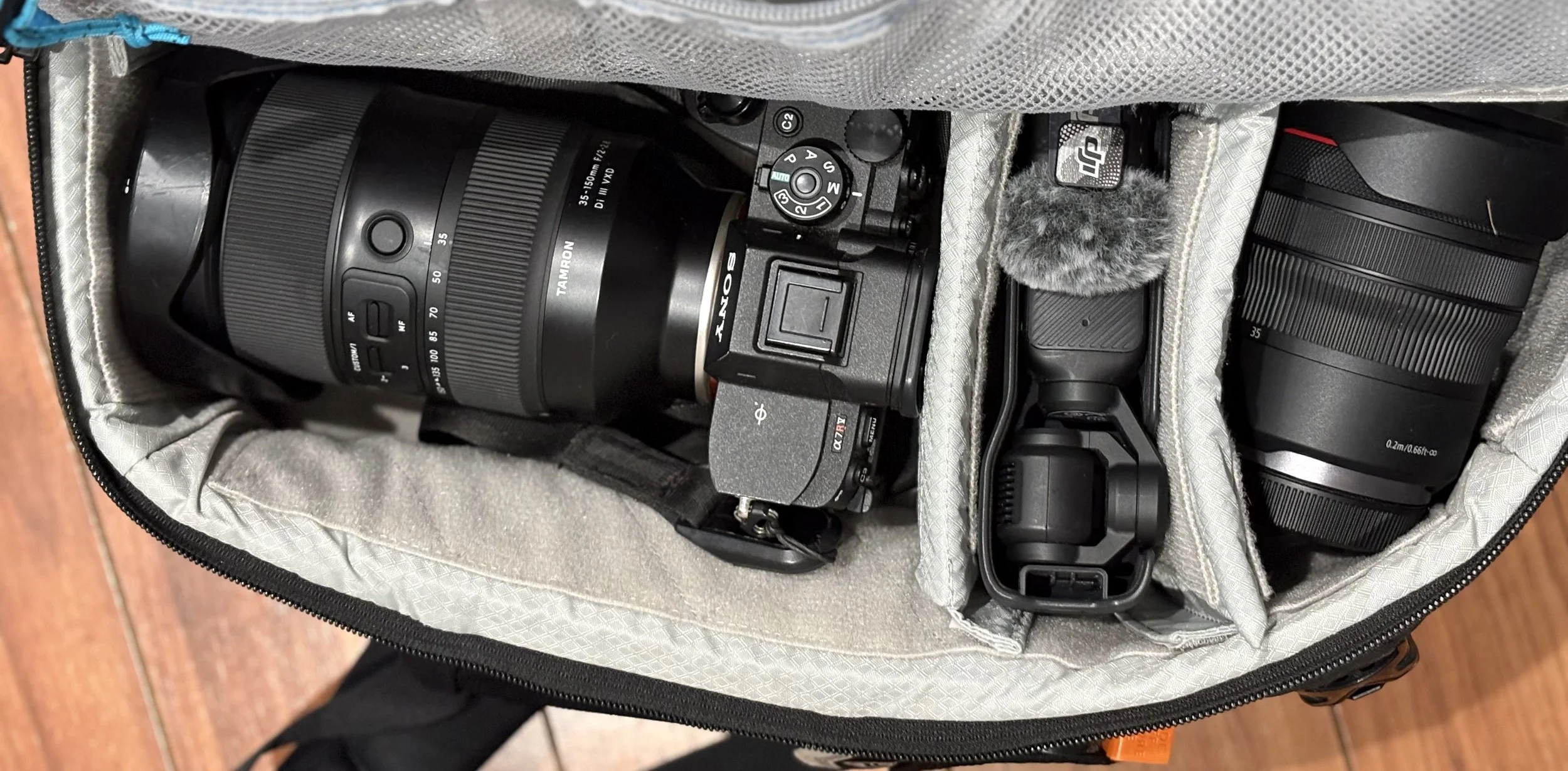
On the other side of the Gura Gear Kiboko 2 16L bag we have the Sony A7R5 with the Tamron 35-150mm, the Canon 14-35 f/4, and the DJI Pocket 3.
I was not expecting to do a lot of bird photography so I left the 200-600mm lens at home. I would love to have been able to use my 500mm primes but both were way to big to carry around with the other gear.
We knew we were going to be shooting exclusively from within the safari vehicle and had the ability to quickly grab one of the two camera. We were also aware that with other shooters in the truck, the possiblity of bumping into one another when shooting out the window or roof top was going to be an issue.
I can say now that I think I took the right gear. I did put the teleconverter on the Canon for much of the trip which gave me working range from 35-150 and 140-560 which was ideal for capturing the animals. We did see more birds than I had expected and there were times where I would have loved to have had a longer reach but for everything else the range was pretty much perfect and 560 was adequate for many of the bird shots. Weather wise it was sunny most of the time we were out so the limitation of smaller apertures of the telephoto didn't really hurt other than reducing the ability to have really nice separation of the subject when there was distracting frenetic backgrounds.
There are some limitations to what you can get when you have to stay in a vehicle and you are pretty much limited to shooting during the day. We did not get a lot of time near dusk or dawn with any animals so I didn't really need to have fast lenses for lower light conditions. It was also very hot during the day so even if I did have a longer lens, shooting animals far away was never going to be useful with the heat haze and shimmering out on the Serengeti plains.
At home I will use the 35-150 for shots where the environment the animal is in is as interesting as the animal itself but most of the time you are not so close that 100mm is wide enough to capture those shots. In Africa there are many times that animals come quite close to the vehicle, and many more times where an elephant or giraffe fill the frame even at 35mm. There were a few times it would have been interesting to get an ultra wide shot of a couple of elephants but the challenge there would have been getting the camera out the window with a multi-tonne animal only a couple of metres away. In any case, with the amount of dust flying around I was definitely not going to change lenses in the vehicle so I left those types of shots to the iphone wide angle lens.
Typical shooting through the canopy with the 100-400 while the 35-150 was ready for any closer shots on the bag at my feet
In general while we were driving through the parks I would have the 100-400 on a strap while standing looking through the roof of the truck with the 35-150 sitting on my camera bag at my feet. We would usually spot an animal (or group of animals) in the distance our driver would find a good spot to see and then we would get a few shots off. Once we were happy with that, our guide would usually find a spot where the animals were like to move towards which allowed us to get ready for closer shots and decide our compositions. Many times the animals would cross fairly close to the truck giving us multiple angles. With many of the big cats we would just sit and watch them as they relaxed in the sun, playing, sleeping and scratching. In these cases I would go back and forth between cameras grabbing closer individual shots and wider shots of the whole family.
While we were in motion I would grab the DJI pocket 3 with its gimballed camera and do a little bit of video of the scenery and as we approached some of the animals.
The one camera I didn't use was the Sony ZV1. It’s a nice point and shoot video oriented camera that I will often put on the hot shoe of my cameras to get a video of what I'm shooting. This was not practical in the safari vehicle. That camera just sat in the camera bag the entire trip.
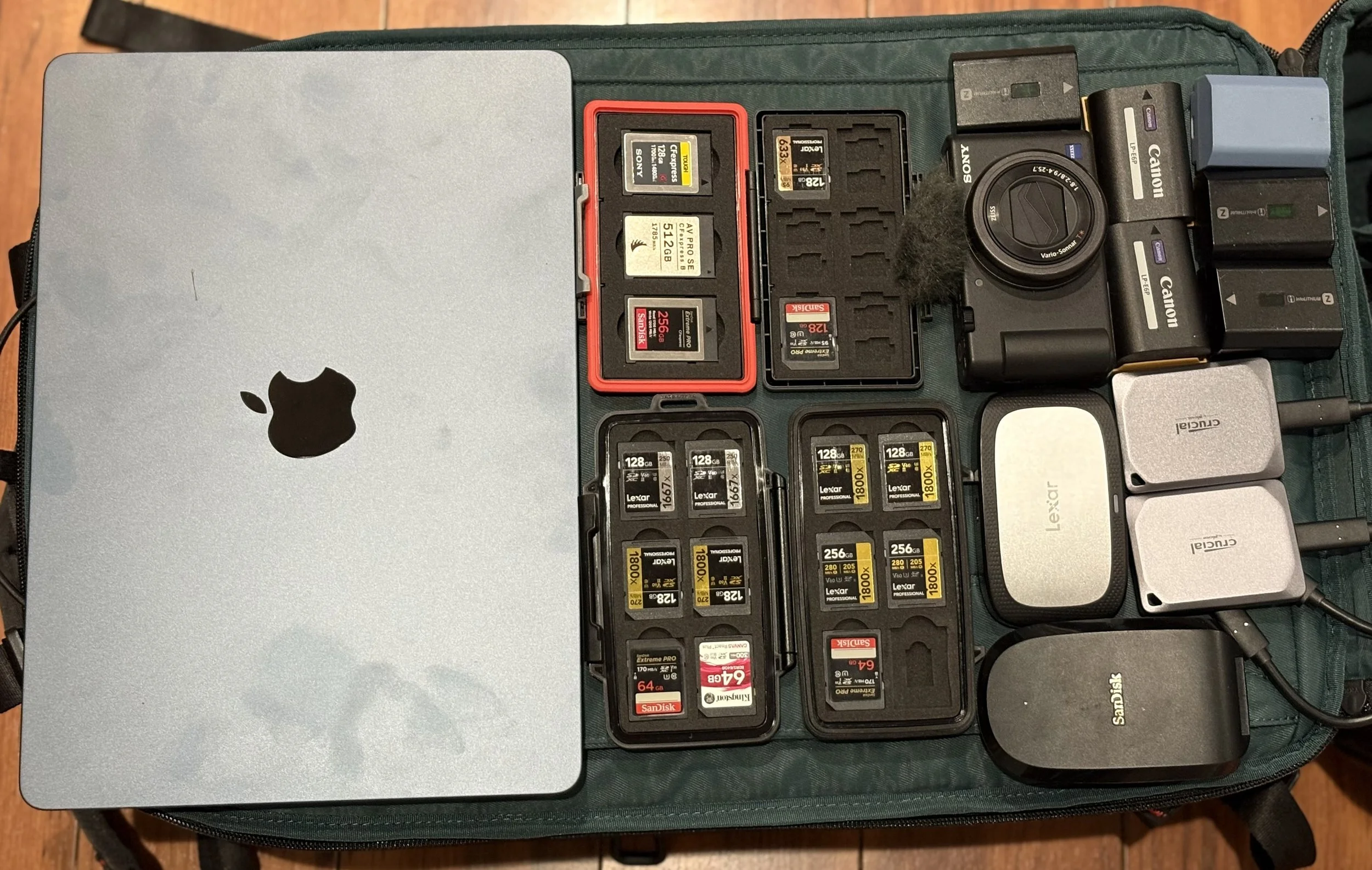
Everything else that was in the bag including Macbook air, plenty of extra cards and batteries, SSDs and card readers for backups and the Sony ZV1
With the other accessories, I had plenty of SD/CF express cards and only needed one SSD but I do like having more than necessary for media. The Macbook Air that I purchased for the trip was fantastic. It was very small and light but was capable to quickly download everything we shot daily whether or not we had power available, and was able to do processing of video and pictures just as quickly as my main computer. I will be happy to travel with this laptop for years.
Battery wise I usually used on full battery each day and started on the second and was able to charge each night so I had enough. I could easily last 3 full days with the Sony batteries but would have likely needed another Canon battery if we had no power available for more than 2 days.
I brought a puffer for blowing out dust and used it every night, but since we didn't change lenses in the field I didn't have to clean the sensor during the trip. I did bring a bunch of sensor cleaning kits and luckily didn't need them. I will always bring them after finding dust on the sensor on our trip to Australia a few years back that took forever to remove via software.
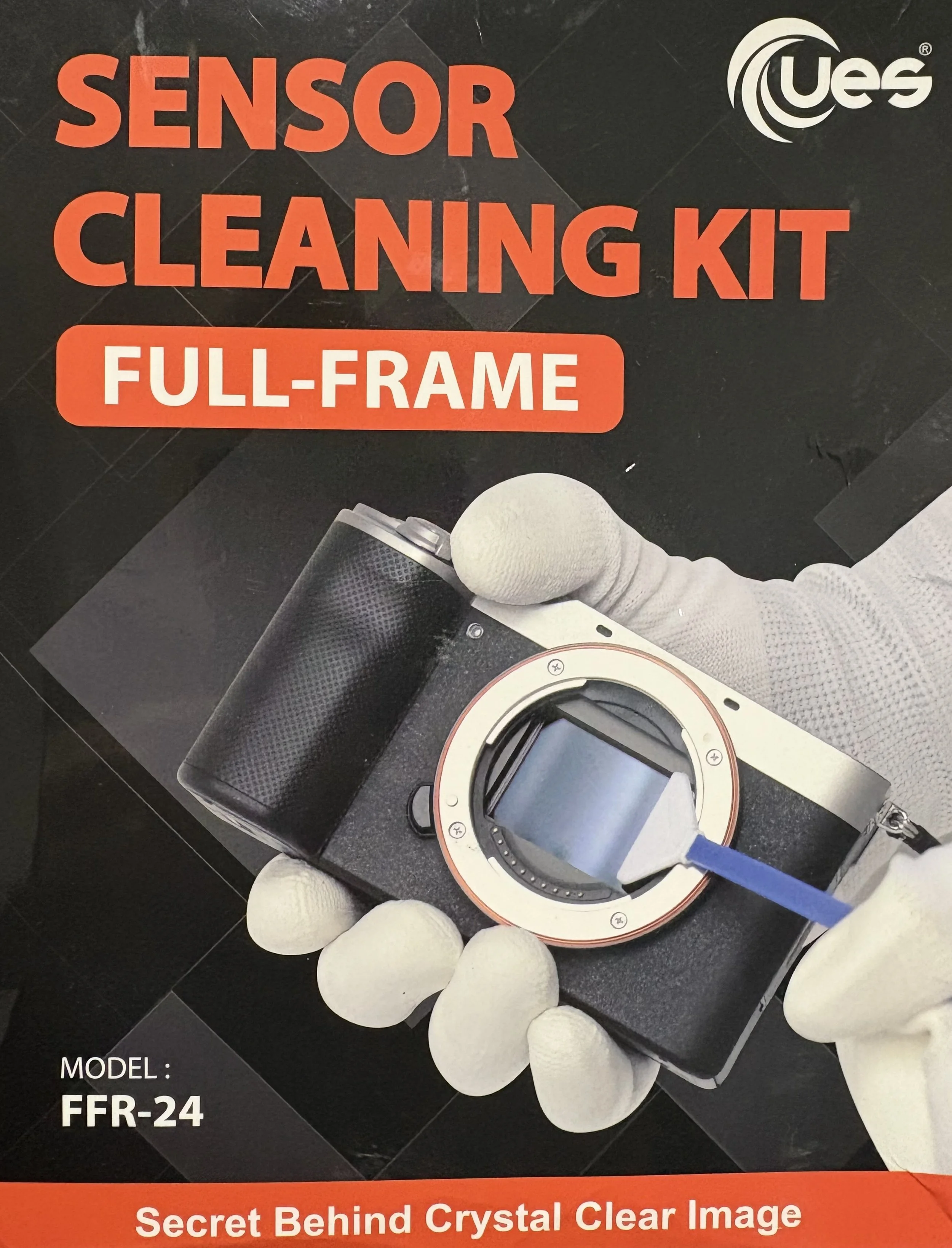
I’ve learned that having a couple of these on a trip can save a lot of work removing spots afterwards.
Thanks to all the advice and research I think I had exactly the gear that I needed for the trip. I would always like to have bigger and brighter lenses but they are impractical for plane travel and can be a pain when you are limited to shooting in tight quarters with other photographers also needing space to shoot. I would likely not take the Sony ZV1 on a similar trip and it is likely the only change I would make if I did the same trip again.
Having 2 different brands of cameras means that I couldn't switch lenses between them if I had a problem with one of the cameras. Usually I like to have that redundancy but at this time that is the best gear I had available. Replacing the Canon gear with a Sony camera that is as useful is not in the budget especially since that would leave a number of expensive glass out of the game. I would have been just as happy using the 200-600 instead of the 100-400 since I often used it with the teleconverter anyways but at the moment I don’t have a second Sony camera that is nearly as good as the Canon R5II for resolution and speed (and likely won’t in the near future).

What's in my bag for Tanzania
We started planning this trip more than 8 months ago so for once I have plenty of time to consider what I need/want to bring with me from a gear perspective.
Option 1: In the left side Canon R5II with EF 100-400 lens attached, 14-35 f/4 RF lens, set of magnetic filters. On the right side we have the Sigma 500 f/5.6, Sony A7R5 with 35-150 f/2-2.8 lens, DJI Osmo Pocket 3, Canon 1.4x EF teleconverter.
We are not long term planners, usually deciding on trips a few weeks ahead and then just doing our own thing without a major schedule or others to rely on. This year we decided to finally do an African safari, basically a trip of a lifetime for us, but we are doing so with 3 other couples. This is a photography trip and we are all nature photographers so at least we will have the same priorities for the most part. We started planning this trip more than 8 months ago so for once I have plenty of time to consider what I need/want to bring with me from a gear perspective. I normally carry a long telephoto zoom and a big white telephoto prime for much of my photography closer to home but I don’t think this is going to be the best gear for this trip. Taking that gear on a number of planes would also be challenging so I have really had to think about what we are going to be shooting, the distances from the subject, how much gear and how heavy my bag will be.
I’ve watched a number of different youtube shows from other photographers on different safaris to try to get some idea of what will be most useful that can all fit in one backpack. The general consensus seems to be that unless the trip is mostly birding you will not really need a super long lens. 400mm is likely as long as will be needed most of the time and with some of the bigger animals you may be close enough to need a normal or wide lens. I always like to do some landscape work while traveling so most likely an ultrawide zoom will be good to have. To keep things light and still have a good assortment of focal lengths zooms will be most practical.
Based on all of that, I think I have determined that the types of photography I will be doing will be closer to the bear photography that I do in the fall where we have larger subjects often at medium to fairly close distances and in low light. To this end I have put together a set of kit that I think I will take on the trip and have been using that most of the time during salmon season this year.
The gear includes the following:
Canon R5II
Canon 100-400 EF f/4-5.6 L
Canon EF 1.4x teleconverter
Canon RF 14-35 f/4 L
Sony A7R5
Tamron 35-150 f/2-2.8
Sigma 500 f/5.6
I will also be bringing along the DJI Pocket 3 and the Sony ZV1 for capturing video as we are shooting. I have also now a new MacBook Air m4 plus a number of external SSD drives for backing up pictures and videos each night.
Accessories going in one of the bags are the Macbook air, 2 small cases of memory cards, extra batteries for all cameras, card readers for CF Express type A and B as well as for SD cards, external SSDs for quick backup of files each night and the trusty Sony ZV1 for quick videos.
To hold everything I have 2 options, a PGYTech Onemo 2 35L camera bag shown above or the Gura Gear Kiboko 16L below. The PGYTech fits everything above fairly easily but with the Gura Gear I would need to leave the 500 Sigma at home. That bag would not have worked at all originally since it can’t fit a large laptop but now with the macbook air I can take either easily. I haven’t made the decision yet but am leaning towards the smaller bag at the moment.
For Option 2 in the Gura Gear bag which is significantly smaller I have the Canon R5II with the EF 100-400 lens and the Canon EF 1.4 teleconverter.
Side 2. I have the Sony A7R5 with the 35-150, Osmo Pocket 3, and the Canon 14-35 f/4. This bag has plenty of storage for all the accessories and a small area that will fit the Macbook air.
During Salmon season this year I have mostly carried the Canon R5II with the 100-400 lens and the Sony A7r5 with the Tamron 35-150 lens and have found this to cover fairly well what I am shooting. Most of the time for these medium sized mammals at distances of between 10-40 metres these lenses have worked out well. I’m hoping most of the time the shooting will be similar from the safari vehicles based on what I have heard from other photographers.
If money were no object, I would absolutely prefer to have a low light beast like the Canon 100-300 f/2.8 along with a couple of teleconverters which would allow for a great range plus good low light performance but that lens is significantly out of budget and I’m hoping Sigma will come out with a new version of their 120-300 at some point for FE mount at a much more reasonable price point.
The 35-150 has turned out to be a very versatile lens for both photography and video. I think that this lens may stay on the Sony camera for much of the trip especially for many of the large animals that we will come across and for more environmental shots with the animals.
The 100-400 range will likely be sufficient for most of the other nature photography and I’m expecting that we will have pretty good light much of the trip. The 1.4 teleconverter is for just in case we see some birds that I can’t pass up the chance of capturing.
If I have the 14-35mm lens on the Canon for some landscape or wide environmental shots then I might switch to the 500mm on the Sony to ensure that I have a long telephoto ready for big cat action. The Sigma 500 is such a light and small super telephoto prime that it may be worth bringing even if I don’t use it most of the time. Salwa will have a 16-35 in her bag if I do need a quick wide angle shot on the A7RV and the Canon is busy.
he main reason for the wide range of the lenses on a trip like this is because most of the time we will be in a safari vehicle and will be unable to get out to change perspective so we will absolutely have to do so with the zoom lenses.
Salwa similarly will be bringing a set of lenses that cover the gamut from 16mm to 560mm with a 16-35 f/4, 24-105 f/4, 100-400 f/4-5.6 and a 1.4 teleconverter all on her Sony A74. It is likely she will be doing a lot more video than I will and she is very comfortable with this lens setup that she takes on most of her video shoots.
The other little things we will be bringing:
Many memory cards for all the cameras.
SSDs for backup
Insta360 X5
Filters (ND and polarizers)
DJI wireless microphone
On camera microphone
Otherwise we will have minimal clothing, a bit of medicine incase of any trip related issues and not much more. Can’t wait to get out there, planning a trip this far ahead is very difficult for us to not get too excited too early. Hopefully I haven’t over examined this with all the time I have had…sometimes overthinking is bad :)
I will revisit my decisions once we come back from the trip to see if we ended up having what we needed or if we should have brought other gear. So far things are working well enough for shooting black bears on the rivers edge and elk out in the fields.