
Canon R5II - long term review and comparison to the R5 and Sony A7RV.
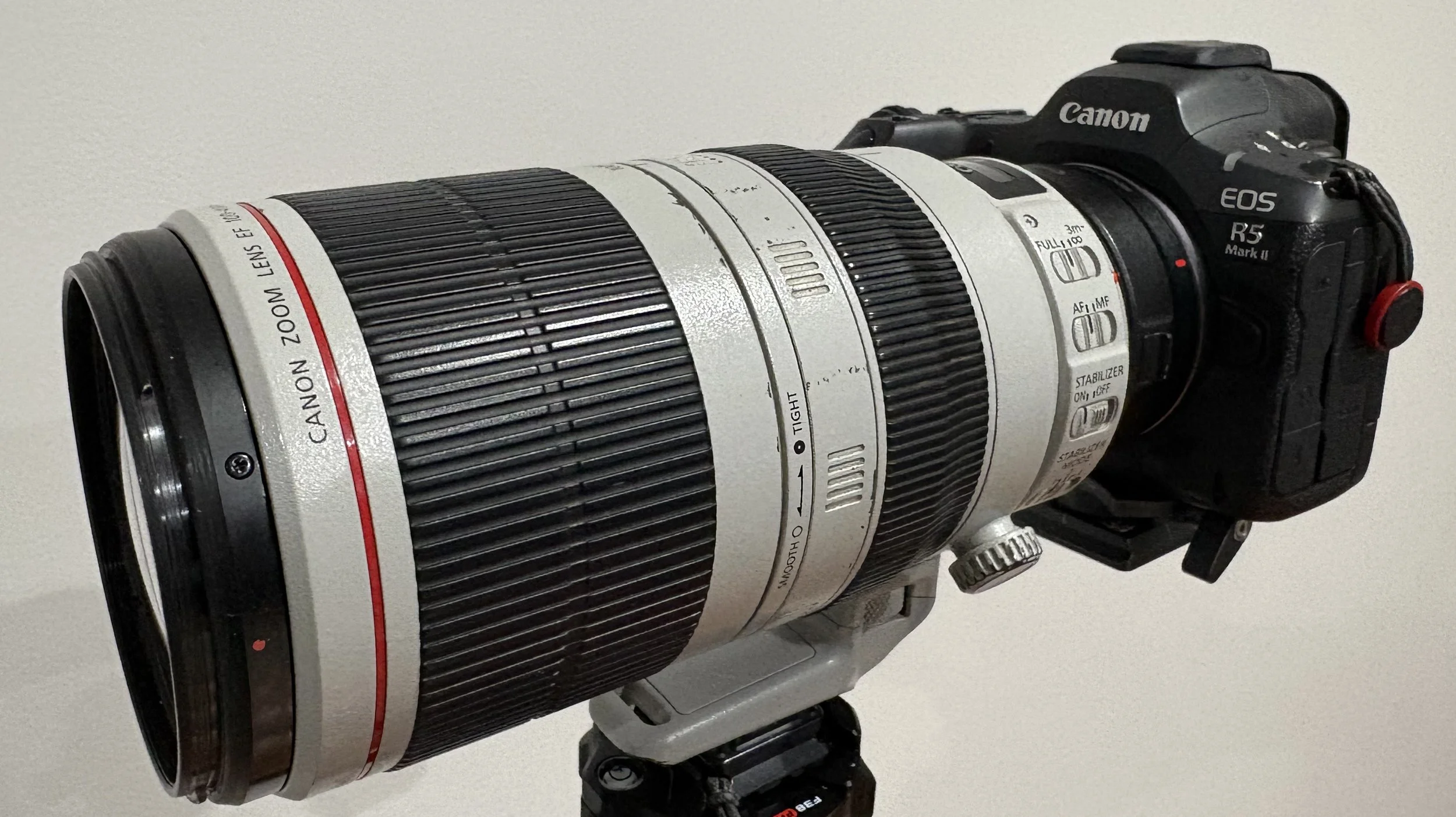
Canon R5II with Canon EF 100-400 L using EF-RF adapter. Probably my most used combination this year for bears along the Quinsam River in the fall and on our Safari trip to Tanzania.
Canon R5II compared to the original R5 and Sony A7RV, three camera I own (or until recently did). I have been using Canon cameras since the late 1990s and have used many Canon and Sony digital SLRs over the years starting with the original digital rebel and many APSC cameras, through all of the 5D series cameras and even a 1D. On the Sony side I started with the A7R and have been using many of the A7R series as my main camera for a good number of years now.
When Canon finally started to get into mirrorless cameras it took them a while to come out with something that I thought was more useful that the 5DS. The first R series cameras were quite underwhelming with mediocre specs and autofocus that was less than stellar compared to the Sony cameras. The R5 came out with many of the features that I was looking for, mainly an autofocus that was similar to the A7R4 that I was using at the time. I purchased the camera shortly after it came out but it turned out to be a rather big disappointment. The version I had was very buggy, which was really unusual to me for a Canon product. I couldn’t rely on it when things counted as it would error out and need to have the battery removed regularly just as I hit the shutter button. This was a shame as the autofocus was really good, the quality of the images was great (very close to the 5DS at low ISO and so much better as the ISO increased) but this camera almost made me sell off the rest of my Canon gear it was so frustrating.
When the R5II came out I was a little nervous about spending that much money in hopes that I would be happy again with Canon. Turns out it was a good decision and this camera is as stable as any of my previous Canon cameras that I had come to rely on, and the improvements over the R5 for the type of shooting that I do was well worth the upgrade. For the first time in quite a few years I have a Canon camera that is as good as my Sonys and is in some ways better (at least for a camera of similar cost right now).
improvements from the R5 to the R5II
So first off let’s look at the improvements on the R5II. The sensor is the biggest change going from a relatively standard CMOS sensor to a stacked sensor. This allows us to actually use the electronic shutter most of the time without much in the way of noticeable rolling shutter in any but the fastest moving things. The second thing is the camera’s reliaablity. I have now had this camera for more than 6 months and I can’t remember a single system crash. The autofocus may be slightly better but the R5 was actually very good. At this point in some situations the Canon is better than my A7RV and in other situations it is the other way around but both do the job in a way that I expect it to work in better than 99% of cases that I will be shooting.
The new pre-capture feature is fantastic and I hope this is something that will come to a similarly priced Sony camera soon. This is great for moments where you are waiting for action to happen and would often just miss the defining moment by a fraction of a second. I can now quickly set up for pre-capture and know that unless I’m completely looking away when something happens I will have a good chance of getting the shot. The 30 fps shooting is also very nice to have although I have found that I usually set it for 20 fps and have the front depth of field button set up to increase back to 30fps when I feel I might need it. That is something that I find a bit annoying since when you hit that buffer limit the camera completely stops shooting unlike the Sony that just reduces the number of frames per second.
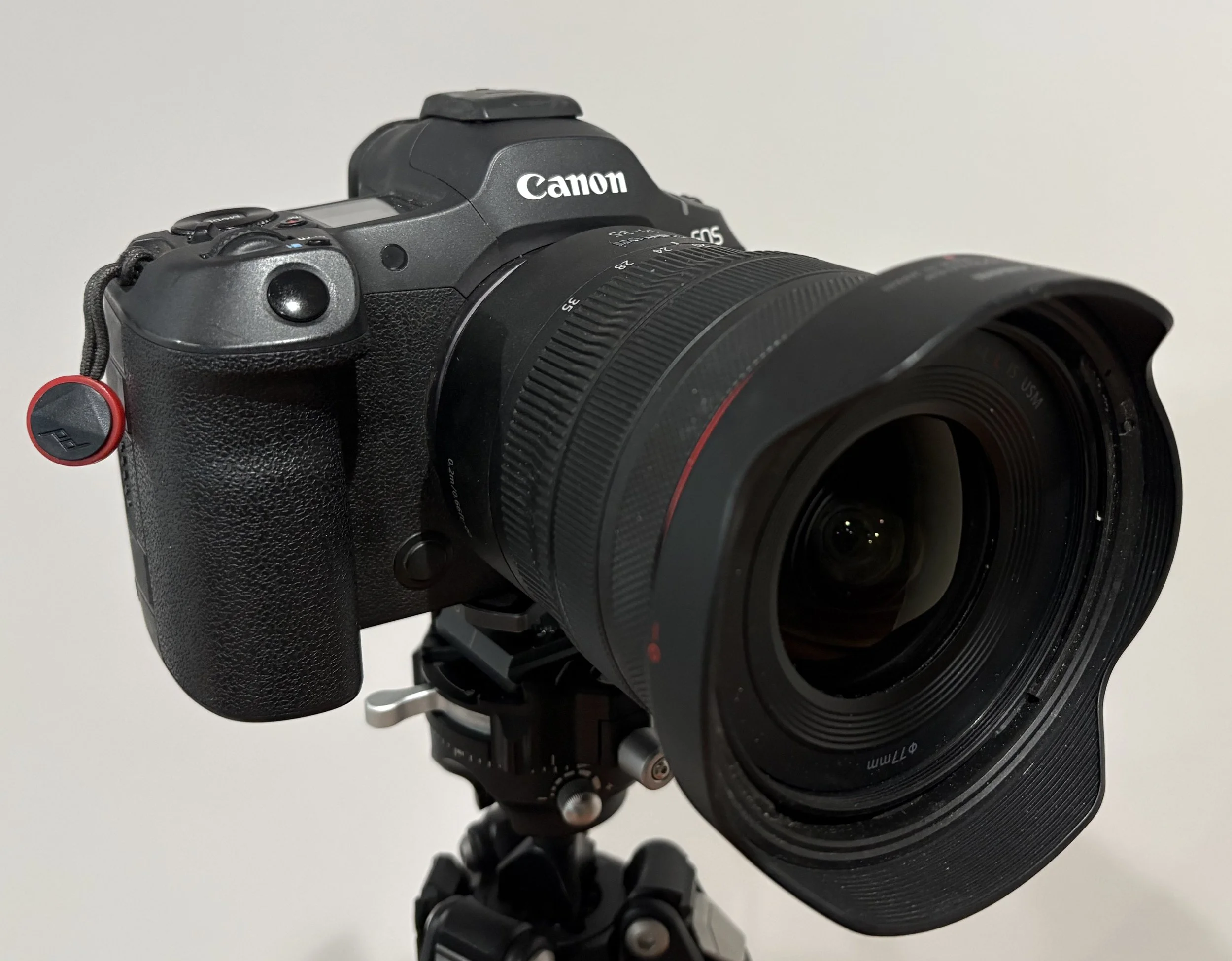
Canon R5II with the only RF lens I currently use, the RF 14-35 f/4 L. I like the extra field of view from our EF 16-35 but both lenses work well on this camera.
The R5 was actually a good camera and was pretty equivalent to the A7R5 that I also use regularly, it was only the reliability of that camera that really was the issue and now that the R5II has come out without those issues and with the improvements noted above, it is possibly a slightly better camera than the Sony. There are other issues with Canon though that make it difficult to just go with one or the other.
RF mount and cost
The new RF mount and the lack of reasonably priced Canon lenses and the total lack of third party lenses is still a big issue. I have now owned a Canon mirrorless camera for a few years and at this time I have only purchased one RF lens. I picked up the 14-35 f/4 lens when prices were a bit cheaper. This is a good lens but I can’t really say it is sharper or than much more useful than the 16-35 f/4 EF lens that we still own and use on the 5DS. I mostly use the EF 100-400, EF 500 F/4 II, EF 100 f/2.8 IS macro, EF Sigma 35 f/1.4, Tamron 85 f/1.8, and Tamron 24-70 f/2.8 lenses with the EF to RF adapter and don’t currently see much reason to purchase much more expensive RF glass.
I have put most of my money recently into FE glass for the Sony system, including Tamron 35-150 f/2.2.8, Sigma 500 f/5.6 and am looking at other new Sigma super telephoto lenses in the future. There are some very good RF lenses out there but they are so expensive and not that much better (if at all) than the recent Tamron and Sigma lenses and even some of the next tier lenses that have improved significantly in the last few years that I don’t see a good reason to make new investment in Canon glass. This may in the end be the reason that I do at some point finally move off of Canon completely. The main saving grace is that the EF lenses that I have work well on the current camera and ones like the 500 f/4 II are so good I can’t get anything better currently for a reasonable price other than maybe the Sigma 300-600.
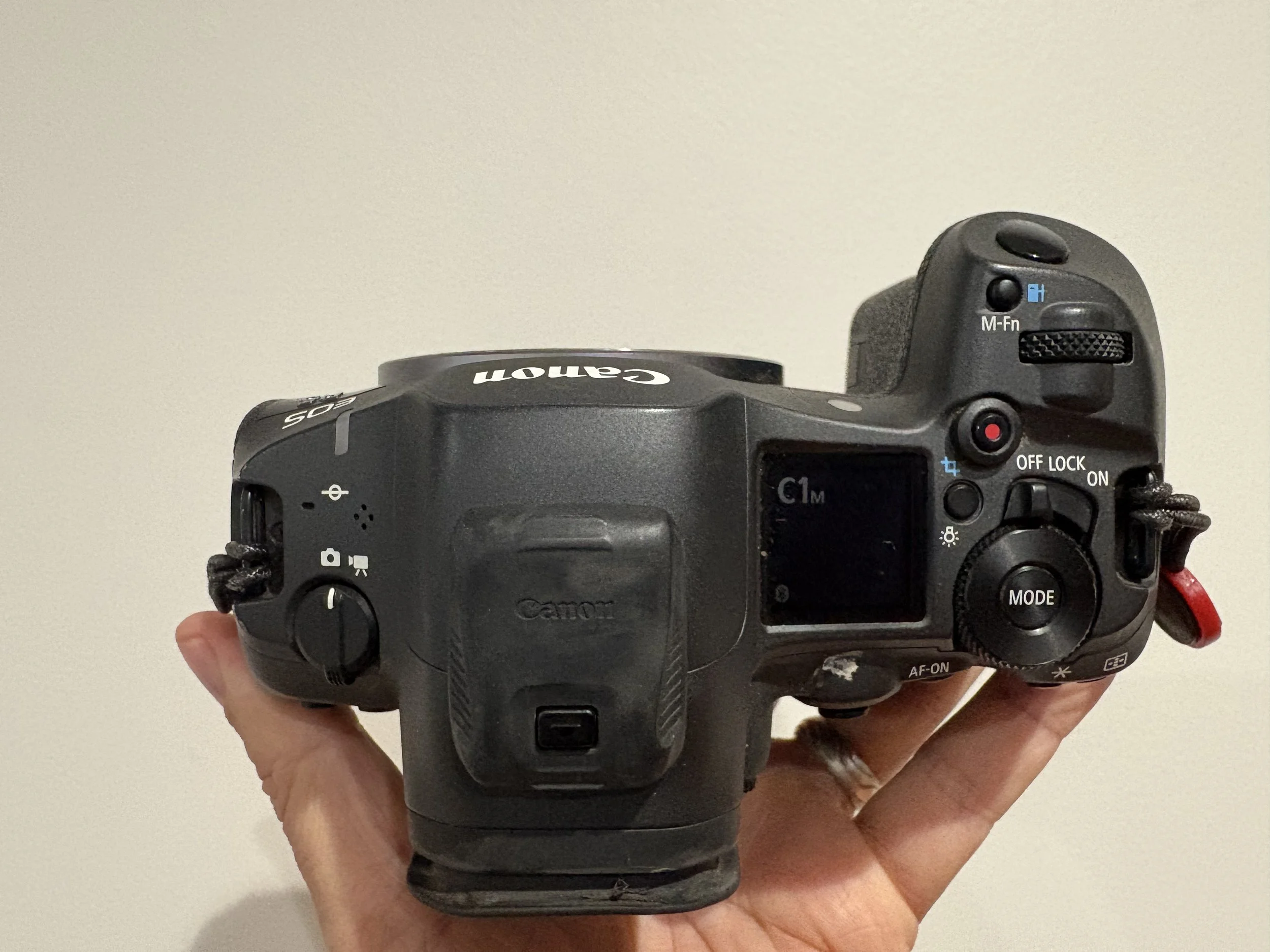
Top view of the Canon R5II. I really like the on/off switch in the new location which makes it quick and easy to turn on the camera while bringing the camera and lens to my eye. I rarely switch to video unless I’m on a tripod so having that switch on the left side of the camera is good for me even though I know other people don’t much like it.
Comparing R5II with the Sony A7R5
This may be a bit of an unfair comparison since Sony currently doesn’t have a stacked sensor camera to compete in the price range of the Canon R5II or the Nikon Z8 so this is really the only option and it is a bit dated now compared to either of those cameras. That being said the Sony A7R5 is a workhorse of a camera. The autofocus is excellent and for the most part on par with the R5II. A maximum of 10 fps though really is limiting now (although I thought it was perfectly adequate for many years). The electronic shutter is basically unusable on this camera except possibly for landscapes but I have no idea why you would want electronic shutter over mechanical in that case other than maybe some camera shake for certain shots. Image quality on both of these cameras is fantastic. I do like to have the extra pixels on the Sony when I need to crop in on animals but I am very happy with the image quality on the 45mp Canon sensor. There are subtle differences when it comes to high ISOs but for the most part I get a similar quality image from both even up to 12800 ISO (I pretty much never shoot higher than that).
When it comes to handling this is very subjective. At this time I prefer the Sony due to the number of buttons and dials that I am able to set up the way I like to shoot. On the Canon I find I have to do multiple button combinations to get the same thing done or use the touch screen (which is not useful when I have the camera up to my eye). I have both cameras set up so that I rarely have to go the the main menu, things are either available directly via buttons and dials or via the quick menu for a few things that I don’t use regularly. The more I use the Canon again the more I get used to the button layout and the only thing I find annoying is changing ISO. This isn’t a game changer because I shoot most nature photography with auto ISO. When I’m shooting landscapes I don’t mind taking my eye from the viewfinder for a few seconds.
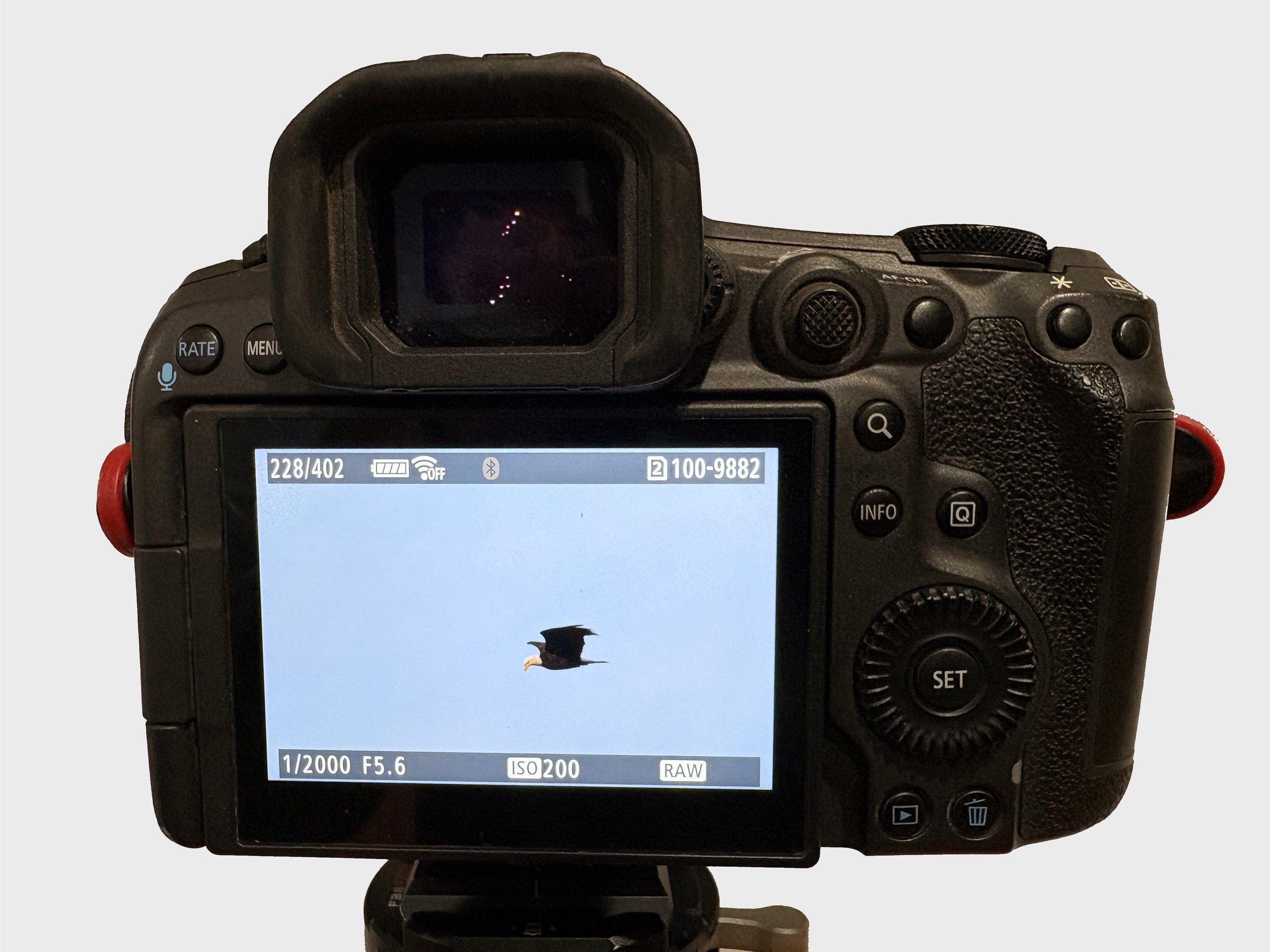
The back of the R5II looks very familiar to anyone having used Canon cameras over the last 20 years but that viewfinder is huge and is a big improvement over the previous version. Not quite as many programmable buttons as the Sony A7RV which does mean I need to go to the quick menu more often than I would like but maybe other photographers prefer the touch screen which is only useful for me when on a tripod shooting landscapes.
the view finder
Speaking of the viewfinder, this is another nice improvement over the R5 and there are features that I have not yet used. The new viewfinder is significantly better in terms of me being able to see through it. I wear glasses all the time and with the R5 I found that if I shot anywhere other than with the sun behind me I was getting glare into the viewfinder that was washing out the image. The new one seems so much better maybe just due to the different shape and size but I really love looking through it now. The new eye autofocus is the one thing that I have yet to try. I want to and would have fun comparing it to my elan 7e which also had eye autofocus but for the most part the cameras autofocus works so well I don’t need another way to focus on an object. I may change my mind after trying it out but that would really just be a bonus.
The LCD screen on the R5II is good and useful but the Sony A7R5 has the best articulating screen out there and really every company should adopt a similar type of articulation. I’m not that picky about the resolution of the LCD so I haven’t really noticed if one is better than the other. For people that shoot with the LCD screen instead of the viewfinder this may be more important. For most of the things I do both screens do the job well enough.
There are so many interesting features on these cameras that I use only a few times a year; exposure bracketing, time lapse, focus stacking, are all things I sometimes do and each camera has something that helps with those types of shots.
Out in the field
I have now had a good amount of time shooting with the R5II after 3 months straight shooting black bears during the salmon spawn this year and a 2 week safari to Tanzania.
First off I can say that this camera is reliable and stable and works as it should which is fantastic. It is really nice being able to use the electronic shutter with the 30 frames per second and being able to be completely silent. The pre-shooting also came in very handy as I waited for bears to launch after a salmon. I have the camera set most of the time now to 20 frames per second with the depth of field button on the front of the camera set up to increase to 30 frames per second when needed. I also have one of the memory positions set so that I can have pre-shooting quickly. I really would like to have it set up so that I can turn on and off pre-shooting with a single press of a button. Not sure if that is an option now on newer firmware but I hope it can be added if it isn’t already.
Autofocus seems to be very similar to the R5 and that is not a bad thing. The R5’s autofocus was very good and the R5 II may be slightly better but I’m not seeing any significant changes. It tends to be a bit better than Sony for capturing the eye on far subjects but lags a bit behind Sony when it comes to subjects close to busy backgrounds and still struggles a bit to find a bird or animal under those conditions. Sony used to have that same sort of issue back with the A7RII but the latest cameras are much better even with very contrasty backgrounds. It is certainly possible that this could be improved via firmware updates but we shall see.
At the moment I have few RF mount lenses, and all of the long telephoto lenses I use for nature photography are EF mount. The 500 f/4 IS II is still an amazing lens and there still isn’t a replacement for it. The pictures from that lens are spectacular which is good since it was the main reason I bought this camera. For the subjects that I have been shooting this year the 100-400 L II has been the most used lens and again has not been given a direct update on RF.
Black bears on the river tend to be in dark conditions but are relatively close. This is where the R5II really shines. Under these conditions I am often shooting higher than ISO 3200 to be able to stop the action and as long as I have the subject reasonably large in the frame I am able to get shots at ISO 6400 and even 12800 that are usable with a bit of noise reduction in post. Compared to the old Canon 5DS this is amazing as I really wouldn’t consider shooting above ISO1600 with that camera which limited the action shots I was able to get in the past. Although the detail is not quite at the level of the Sony which has 61 MegaPixels most of the time the difference is not extreme. I do still find that things like feather details are still a bit better with the Sony but only nature lovers tend to look that close.
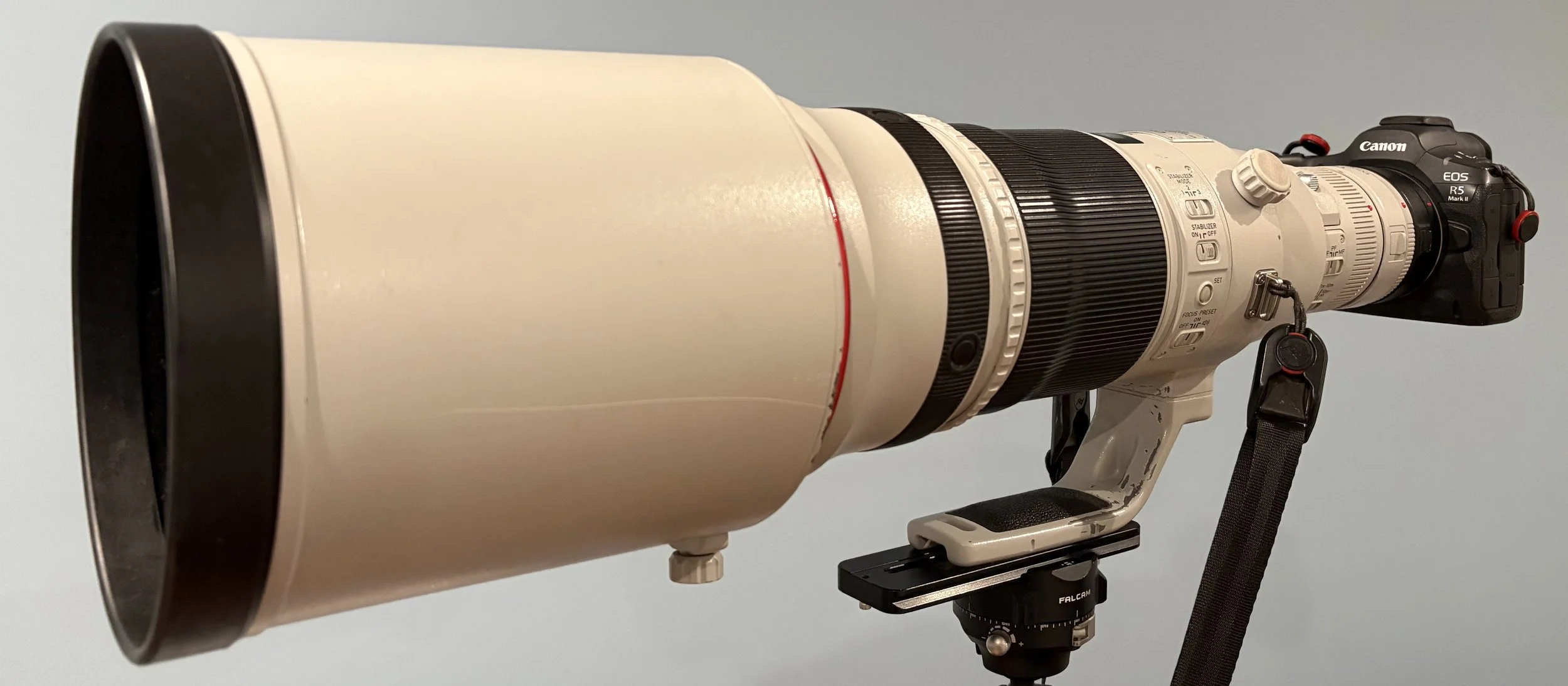
The main reason I bought the R5II was to be able to continue to use my EF 500mm f/4 IS II. This lens is my favourite birding lens and with the 1.4 teleconverter as seen here I get fantastic image quality and am able to track subjects quickly. I don’t know if Canon will ever produce a new 500mm but I doubt it will come in anywhere near the same price as this gem.
The reason I have dropped my shooting speed down to 20 frames per second is mainly due to the buffer in the R5II. Although it is better than previous 5 series cameras it still runs out fairly quickly and when it does shooting stops completely. I don’t tend to put the shutter down until the buffer is full but I will tend to do short bursts as the action is happening and have hit the buffer more often than I would like. I have missed shots due to the fact that the camera won’t allow any more shots until it clears. Would love to see an update so that it would act more like the Sony which slows down but continues to shoot once the buffer is hit. I have found that at 20 frames per second I don’t hit the buffer nearly as often and for the most part the subjects I have been shooting it is fast enough to ensure I get the best wing position or the action at the right time more often than not.
In the end what I can say is the R5II has become my favourite Canon camera of all time and I’m finding it to be as consistent and capable as my trusty A7RV. For nature photography I would say it is Canon’s best camera up to this point in time.